Gloria Klein is an American abstract painter whose mature works are rooted in repetition and systemic order. Guided by an enigmatic and self-determined logic, her works feature patterned fields that push against the limits of comfort. Repeated diagonal strokes form dense frequencies evoking psychological or urban chaos: the jostling of bodies in a crowd, visual overload of signage, or coded language of digital information. Color is the carrier and distributor of meaning; she visualizes the complexity of people and society – its problems and solutions, movements, feelings, and experiences – through pure abstraction. Klein’s obsessive pursuit of order exposes a tension between the cool authority of a system and the messy realities of lived experience.
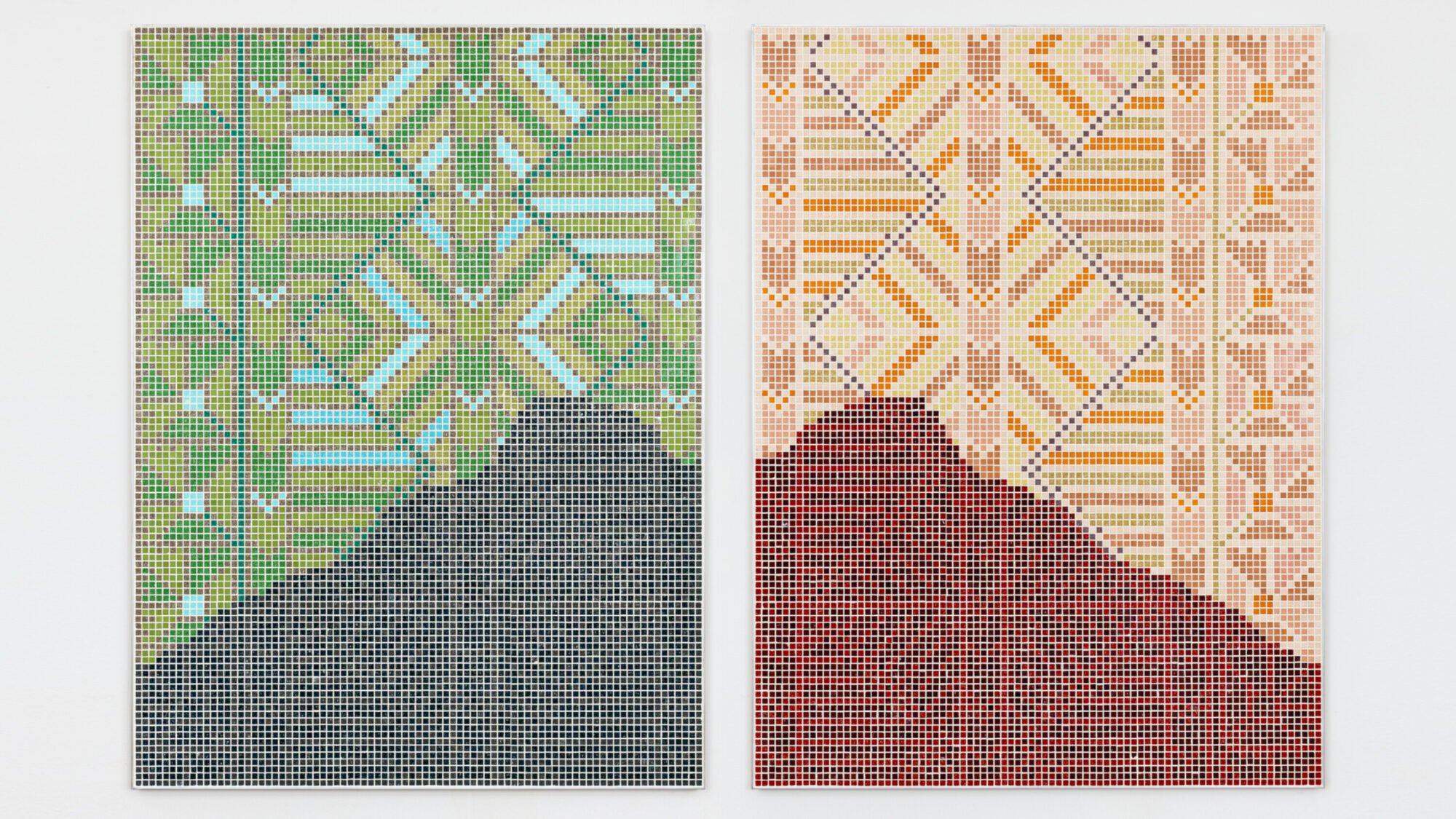
Jordan Nassar’s mosaics and hand embroidered textile pieces address an intersecting field of language, ethnicity and the embedded notions of heritage and homeland. Broadly inspired by Byzantine tilework and architectural ornament, his mosaic landscapes function as material expressions of excavation and personal archeology. Treating craft within its capacity as communicative form, Nassar examines conflicting issues of identity and cultural participation using geometric patterning adapted from Islamic symbols present in traditional Palestinian tatreez embroidery. Whether rendered in tile or thread, Nassar’s colorful landscapes collapse distance, casting the gaze toward imagined horizons shaped by memory and longing.
Krzysztof Strzelecki works across a variety of media with a particular focus on ceramic vessels that explore homoeroticism and human sexuality. Growing up isolated and homosexual in rural Poland, the scenes depicted in Strzelecki’s ‘Cruising Fantasies’ emerge from the longing for an erotic and romantic escape. Surfing the web, browsing apps, and his own personal archive of photography, the artist immortalizes these images of desire and connection on his vessels. In an array of vivid colors and shapes, at times evoking cactus, waves, fruit, or even apartment buildings, Strzelecki creates his own world where his subjects inhabit their environments freely and unselfconsciously.


![This image depicts an artwork by Jordan Nassar titled "I'd rather give back the waves to the sea." This artwork was created in 2026 and measures 37 ¹⁄₂" x 49" x 1" [HxWxD] (95.25 x 124.46 x 2.54 cm). Its medium is Hand embroidered cotton on cotton.](https://anatebgi.com/wp-content/uploads/2026/01/Jordan-Nassar_JN1342_1769206577.jpg)
![This image depicts an artwork by Krzysztof Strzelecki titled "Beneath the Blossoms." This artwork was created in 2025 and measures 16" x 9 ¹⁄₂" x 6" [HxWxD] (40.64 x 24.13 x 15.24 cm). Its medium is Acrylic and glazed stoneware ceramic.](https://anatebgi.com/wp-content/uploads/2026/01/Krzysztof-Strzelecki_SK1141_1769206589.jpg)
![This image depicts an artwork by Krzysztof Strzelecki titled ""Vase 2"." This artwork was created in 2025 and measures Installed 21" x 15 ¹⁄₂" x 7 ¹⁄₂" [HxWxD] (53.34 x 39.37 x 19.05 cm)Base 19" x 15 ¹⁄₂" x 7 ¹⁄₂" [HxWxD] (48.26 x 39.37 x 19.05 cm)Lid 5" x 7" x 7" [HxWxD] (12.7 x 17.78 x 17.78 cm). Its medium is Unglazed ceramic stoneware.](https://anatebgi.com/wp-content/uploads/2026/01/Krzysztof-Strzelecki_SK1151_1767907893.jpg)
![This image depicts an artwork by Gloria Klein titled "Untitled (Diptych)." This artwork was created in 1980 and measures 62" x 120" [HxW] (157.48 x 304.8 cm). Its medium is Acrylic on canvas.](https://anatebgi.com/wp-content/uploads/2026/01/Gloria-Klein_GK1033_1769206559.jpg)


![This image depicts an artwork by Krzysztof Strzelecki titled "Blue Sky." This artwork was created in 2025 and measures 9 ³⁄₄" x 7 ³⁄₄" x 2" [HxWxD] (24.77 x 19.69 x 5.08 cm). Its medium is Unglazed ceramic stoneware.](https://anatebgi.com/wp-content/uploads/2026/01/Krzysztof-Strzelecki_SK1145_1769206592.jpg)
![This image depicts an artwork by Krzysztof Strzelecki titled "With Red Ribbon." This artwork was created in 2025 and measures 9 ³⁄₃₂" x 6 ⁷⁄₈" x 1 ²⁵⁄₃₂" [HxWxD] (23.11 x 17.5 x 4.5 cm). Its medium is Unglazed ceramic stoneware.](https://anatebgi.com/wp-content/uploads/2026/01/Krzysztof-Strzelecki_SK1146_1769206591.jpg)
![This image depicts an artwork by Krzysztof Strzelecki titled "Laundry Breeze." This artwork was created in 2025 and measures 8 ¹⁵⁄₃₂" x 7 ³⁄₃₂" x 2 ⁵⁄₃₂" [HxWxD] (21.49 x 18.03 x 5.51 cm). Its medium is Unglazed ceramic stoneware.](https://anatebgi.com/wp-content/uploads/2026/01/Krzysztof-Strzelecki_SK1147_1769206590.jpg)
![This image depicts an artwork by Jordan Nassar titled "At sunset as at sunrise." This artwork was created in 2026 and measures 48" x 36" [HxW] (121.92 x 91.44 cm). Its medium is not known.](https://anatebgi.com/wp-content/uploads/2026/01/Jordan-Nassar_JN1341_1769206679.jpg)
![This image depicts an artwork by Jordan Nassar titled "Red is the sun." This artwork was created in 2026 and measures 48" x 36" [HxW] (121.92 x 91.44 cm). Its medium is Glass tile and cement grout on aluminum.](https://anatebgi.com/wp-content/uploads/2026/01/Jordan-Nassar_JN1343_1767890163.jpg)


![This image depicts an artwork by Gloria Klein titled "Untitled 34." This artwork was created in 1975 and measures 66" x 60" [HxW] (167.64 x 152.4 cm). Its medium is Acrylic on canvas.](https://anatebgi.com/wp-content/uploads/2026/01/Gloria-Klein_GK1019_1767907835.jpg)
![This image depicts an artwork by Gloria Klein titled "Untitled." This artwork was created in 1974 and measures 50" x 30" [HxW] (127 x 76.2 cm). Its medium is Acrylic on canvas.](https://anatebgi.com/wp-content/uploads/2026/01/Gloria-Klein_GK1014_1769206567.jpg)
![This image depicts an artwork by Rogan Gregory titled "Nymphaea Table." This artwork was created in 2026 and measures Table 30" x 45" x 39" [HxWxD] (76.2 x 114.3 x 99.06 cm)
Chair (1) 33" x 17" x 23" [HxWxD] (83.82 x 43.18 x 58.42 cm)
Chair (2) 34" x 17" x 25" [HxWxD] (86.36 x 43.18 x 63.5 cm). Its medium is Steel, white gypsum, bespoke terrazzo.](https://anatebgi.com/wp-content/uploads/2026/01/Rogan-Gregory_RG1000_1769206643.jpg)
